

How To Say Sugar Skulls In Spanish

A sugar skull, a common gift for children and decoration for the Day of the Dead.
A calavera (Spanish – pronounced [kalaˈβeɾa] for "skull") is a representation of a man skull. The term is nearly often practical to edible or decorative skulls made (commonly by hand) from either sugar (called Alfeñiques) or dirt, used in the Mexican celebration of the Day of the Dead (Spanish: Día de Muertos) and the Roman Catholic vacation All Souls' Day. Calavera can also refer to whatever creative representations of skulls, such every bit the lithographs of José Guadalupe Posada. The most widely known calaveras are created with cane carbohydrate and are decorated with items such every bit colored foil, icing, beads, and feathers. They range in multiple colors.[one]
Traditional methods for producing calaveras have been in utilize since the 1630s.[2] The skulls are created either for children or as offerings to exist placed on altars known as ofrendas ("offerings") for Día de Muertos, which has roots in the Aztec, Mayan, and Toltec cultural commemoration of the "Mean solar day of the Dead".[three]
The tradition of carbohydrate skulls is for families to decorate their loved ones' ofrendas with both large and small handmade carbohydrate skulls.[four] Children who have died, represented by small saccharide skulls, are historic on 1 November. The larger sugar skulls represent the adults, whose celebration takes identify on two November. It is believed that the departed render habitation to enjoy the offering on the altar.[v]
In pre-Columbian times, the images of skulls and skeletons were shown oft in art forms to correspond rebirth into the side by side stage of life. During the 20th century, political caricaturist José Guadalupe Posada became famous for making calaveras as vain skeletons dressed in the clothing of the wealthy. The nearly famous one was Catrina, wearing a feathery hat, fancy shoes and a long dress. Catrina is considered to be the personification of the Day of the Dead.[three] These skeletons are created from many materials such as woods, saccharide paste varieties, types of nuts, chocolate, etc. When used every bit offerings, the proper noun of the deceased is written across the forehead of the skull on colored foil.
Production [edit]

Sugar skulls before decoration.
Traditional production methods have been in use since roughly the 15th century. The process involves using molds to bandage the calaveras. Production can be a lengthy process: a craftsman will usually spend roughly four to six months producing the skulls for a season. Traditionally made sugar skulls are considered folk art and are non meant to exist consumed.[ii]
The production process is more focused on the artful appeal of the skull than on the gustation or nutrient safety of the production. Furthermore, many calaveras feature inedible decorations, such as beads, feathers, and foil. Some skulls were formerly decorated with sombreros, although these designs have mostly disappeared since the 1970s.[2]
The calaveras are traditionally sold at outdoor market place stalls beginning two weeks earlier the Twenty-four hours of the Expressionless.[ citation needed ]

Sugar skulls offered for sale in Mexico.
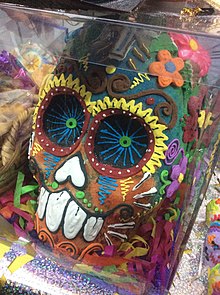
Big sugar skull offered for sale in United mexican states.
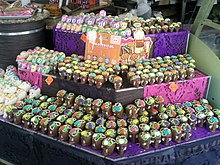
"Calaveritas" (lilliputian skulls) made of chocolate and sugar for auction in Mexico.
Other calaveras are produced to exist edible. Most are cast as ane piece from cane sugar, which can either be left unflavored or else flavored with vanilla.[6] Some calaveras are also made from chocolate. The calaveras are typically colored with vegetable dyes. As with the more decorative calaveras, these volition sometimes have names written on the foreheads, as well. Calaveras may exist eaten, or kept for a few days and then thrown away.[ citation needed ]
Clay skulls [edit]
Clay toy variations of calaveras also resemble the shape of human skulls. These toys are oftentimes painted a metallic argent color, but they may also be plant in colors such every bit white, black, and red. Beaded optics of many colors may likewise be added for ornamentation.[ commendation needed ]
Literary calaveras [edit]
Poesy written for the 24-hour interval of the Dead are known equally literary calaveras, and are intended to humorously criticize the living while reminding them of their mortality.[seven] [8] Literary calaveras appeared during the second half of the 19th century, when drawings critical of important politicians began to be published in the press. Living personalities were depicted as skeletons exhibiting recognizable traits, making them easily identifiable. Additionally, drawings of expressionless personalities frequently independent text elements providing details of the deaths of various individuals.
Face painting [edit]
Sometimes known equally "sugar skull" make-upwardly, or Catrina make-up, facepainting a skull with ornate elements is a pop element of Day of the Dead celebrations in Mexico.[9] [10]
-

Sugar skull brand-up.
See besides [edit]
- Calaca
- Papel Picado
- La Calavera Catrina
- Santa Muerte
- Manuel Calavera
References [edit]
- ^ Well-nigh an José Guadalupe Mexicano Posada'southward Calavera Revolucionaria , Chicana and Chicano Space, archived from the original on 4 April 2008, retrieved 19 June 2018,
Posada created many images of calaveras (skeletons) performing many different human activities. These images were/are used for the Day of The Expressionless celebrations in Mexico.
- ^ a b c "Twenty-four hour period of the Dead ~ Frequently Asked Questions". world wide web.mexicansugarskull.com. Reign Trading Co. Archived from the original on 19 June 2018. Retrieved 19 June 2018.
- ^ a b Turim, Gayle (2 Nov 2012). "Twenty-four hours of the Dead Sweets and Treats — Hungry History". History TV. Archived from the original on 10 March 2018. Retrieved 19 June 2018.
- ^ Chef, Katelyn (28 October 2016). "A Sweet History of Sugar Skulls on Solar day of the Dead". Martha Stewart. Retrieved 19 June 2018.
- ^ Gavrilova, Anabela (12 August 2013). "Saccharide Skulls' status in pop culture: What is their pregnant and where do they originate from?". Cruel Daze of Summertime . Retrieved nineteen June 2018.
- ^ Brandes, Stanley (8 January 2007). Skulls to the Living, Breadstuff to the Dead: The Day of the Dead in Mexico and Beyond. Wiley-Blackwell. p. 43. ISBN978-ane-4051-5248-8.
- ^ Rangel, Sonia. "Calavera poetry reading slated for Nov. 1". Tejano Tribune. Archived from the original on 28 July 2009. Retrieved xix June 2018.
- ^ Barradas, Francisco (ane November 2007). "Calaveras and Posadas". El Tecolote. Archived from the original on 19 November 2007. Retrieved 19 June 2018.
- ^ Devash, Meirav. "5 Things to Know Before Doing Dia de Los Muertos Makeup". Allure . Retrieved 2018-10-07 .
- ^ Bachman, Stephanie. "The Origins of Sugar Skull Facepaint: Twenty-four hour period of the Dead". Retrieved 2018-x-07 .
External links [edit]

Expect up calavera in Wiktionary, the free dictionary.
- Information about Jose Guadalupe Posada, Posada Art Foundation
- Data about calaveras de azúcar, Decalaveras Foundation
- Information about calaveras literarias, Calaveras Foundation
Source: https://en.wikipedia.org/wiki/Calavera
0 Response to "How To Say Sugar Skulls In Spanish"
Post a Comment